Tel: +86-18065255079 E-mail: wulixia@vameitulvye.com
Whatsapp:+86 15260985928
English
- All
- Product Name
- Product Keyword
- Product Model
- Product Summary
- Product Description
- Multi Field Search

Views: 0 Author: Site Editor Publish Time: 2026-07-08 Origin: Site


A window that brings fresh air into a classroom or patient room can also create risks if its opening, glass, or hardware is poorly matched to the people using the space. Children may climb near an open sash, while vulnerable patients may need tighter control over how far a window can move. An Aluminum Casement Window can address these concerns through a rigid frame, controlled opening, safety glazing, secure locking, and room-specific installation. The sections below explain how these features work together and what schools and hospitals should verify before choosing a system.
A safe window depends on its parts staying aligned through years of use. Aluminum provides a strong, stable base for hinges, locks, glazing beads, and perimeter seals, helping the sash close consistently after frequent operation. That rigidity suits busy classrooms, corridors, wards, and treatment areas. Durable finishes also help in humid or frequently cleaned locations.
Material strength is only the starting point. The safety of an Aluminum Casement Window also depends on profile design, corner construction, hardware attachment, glass retention, and anchors connecting the unit to the wall. Weak fixings can still let a rigid frame rack or separate. Specifiers should assess the installed Aluminum Casement Window rather than treating aluminum as a guarantee.
When the sash closes, the locking action pulls it against seals around the perimeter. This compression closure limits movement, while multi-point locks spread holding force along the frame instead of concentrating it at one latch. Together, these features can improve operational reliability and make localized prying more difficult.
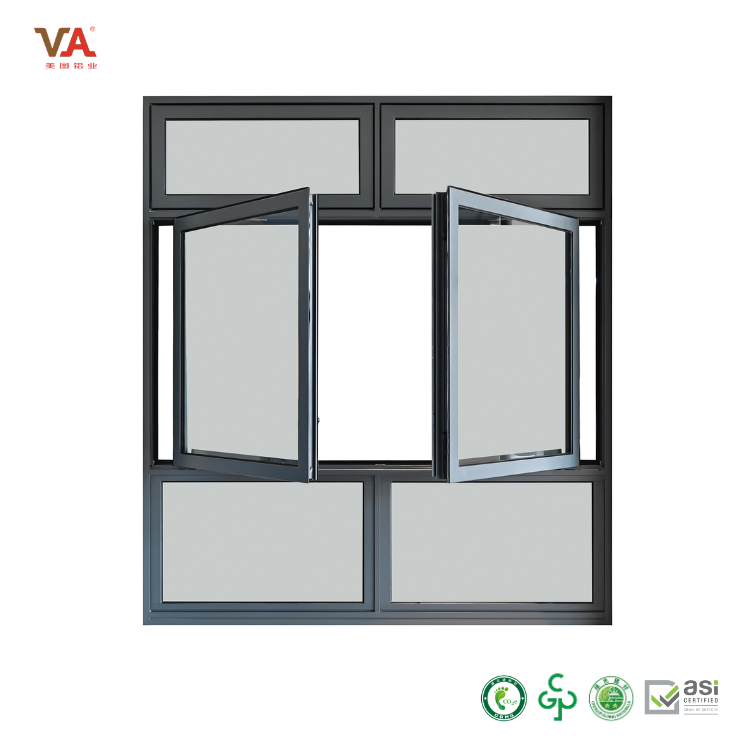
An inward-opening Aluminum Casement Window can also simplify inspection and cleaning from inside. VA Aluminum’s customized inward-opening double-glazed model combines multi-point locking, optional tilt ventilation, anti-drop frame recesses, epoxy anti-drop screws, sealed joints, and indoor cleaning access. Those features still require careful room planning because the sash must not strike beds, desks, equipment, curtains, circulation routes, or emergency paths.
Ventilation becomes hazardous when an operable sash opens far enough for a child or vulnerable patient to fall. Early-years classrooms, upper-floor teaching spaces, pediatric units, dementia care areas, and rooms used by people with impaired judgment need particular attention. A suitable restrictor limits the opening while allowing controlled airflow. Staff may use a key or specialist tool for approved release.
The restrictor must resist foreseeable pressure, repeated operation, and deliberate tampering. Its fixings and release mechanism matter because a strong stay is useless if it pulls out. Where vulnerable people face a fall risk, openings are commonly restricted to approximately 100 mm or less, subject to local rules and a project-specific risk assessment. Restrictors must also be checked for mechanical weaknesses that could cause them to disengage under force. The Aluminum Casement Window needs both a suitable opening limit and hardware capable of maintaining it.
Furniture placement belongs in the same assessment. Desks, shelves, and bedside equipment can create climbing routes. Screens are not fall barriers and should never be treated as substitutes for restrictors or guards. Keeping furniture away from windows can reduce the likelihood that children or vulnerable occupants gain access to the sill.
Everyday ventilation and emergency egress are separate functions. A restricted Aluminum Casement Window should not automatically be treated as an escape route. Egress must be checked against local codes, fire strategy, staffing, and occupant abilities.
The moving sash can create its own hazards. Inward-opening leaves may collide with occupants, obstruct walkways, trap fingers near hinges, or move suddenly in strong winds. Handles should be accessible to authorized staff but difficult for unsupervised children or vulnerable patients to operate. Stops, stays, and room layout should be coordinated before finalizing the opening direction.
Natural ventilation must also fit the wider indoor-air strategy. Open windows can introduce fresh air, but their operation must be coordinated with mechanical ventilation, thermal comfort, outdoor air quality, and weather conditions. In high-risk rooms or locations affected by outdoor pollution, fixed glazing or specialist ventilators may be more appropriate.
A strong frame cannot compensate for glazing chosen without reference to the hazard. Tempered glass is heat-treated to break into relatively small fragments rather than large sharp shards. Laminated glass uses an interlayer that helps hold broken pieces together, reducing the chance that an immediate open hole will form. The choice should follow the expected impact.
Classrooms, corridors, pediatric rooms, ground-floor windows, and pharmacies face different impact and security risks. Thickness alone does not settle the issue because panel size, edge support, interlayer type, framing, and tested performance affect the result. Windows and other transparent surfaces in hazardous locations should use suitable safety glazing or protective measures against breakage and carry the required identification markings.
Glazing option | Primary safety purpose | Typical institutional use |
Tempered safety glass | Reduces severe cutting hazards after breakage | Classrooms, corridors, doors, activity areas |
Laminated safety glass | Retains fragments and preserves a temporary barrier | Low-level glazing, pediatric rooms, accessible windows |
Security-laminated glass | Delays penetration in a tested system | Selected perimeter zones, pharmacies, reception areas |
Safety glazing and security glazing are not interchangeable. One mainly reduces injury after breakage; the other is selected to delay penetration under a defined attack method. An Aluminum Casement Window intended for delayed forced entry needs compatible laminated glass, secure glazing beads, reliable gaskets, stiff profiles, protected hinges, multi-point locks, and anchors that transfer loads into the wall.
Avoid descriptions such as “unbreakable” or “intruder-proof.” Schools should identify protected assets, potential threats, likely attack methods, vulnerabilities, and the required delay before selecting a test or certification level. A pharmacy, ward, and behavioral-health room may need different specifications despite using the same window format.
School safety is shaped by predictable behavior as much as by structural loads. Children may climb on furniture, pull handles, defeat restrictors, or strike glass. Ground-floor openings can become access points, while upper floors increase fall consequences. The Aluminum Casement Window should keep operation under staff control without hindering ventilation.
Controls may need to sit outside easy student reach, yet teachers and facilities teams must operate them consistently. Restrictors should be inspectable, hard to release with classroom objects, and durable. Furniture layouts should be reviewed whenever rooms are reorganized because a desk or shelf can change access to the sill. Delayed-entry glazing may be justified at selected perimeter locations, but only after a security assessment.
Hospital specifications vary because mobility, cognition, age, treatment, and supervision change risk. An office may use a conventional Aluminum Casement Window, while a pediatric ward, rehabilitation room, dementia unit, or upper-floor bedroom may need restricted operation and tamper-resistant hardware. The design should account for beds, equipment, observation lines, and cleaning routines.
Authorized operation must remain practical. Staff may need a controlled override, but a vulnerable patient should not be able to release the limiter with common objects. Easy-clean surfaces and inward access can support maintenance, provided the sash does not enter the patient zone. Falls from windows can cause serious or fatal injuries, making both premises-level and individual risk assessments necessary wherever occupants may be vulnerable.
Behavioral-health settings should not receive a standard commercial detail by default. Projecting handles, hinges, cords, removable components, and conventional restrictors may create ligature, tampering, or impact risks. Some rooms require anti-ligature hardware, tamper-resistant fixings, impact resistance, fixed glazing, or controlled ventilation.
These decisions belong within an environmental risk assessment led by the healthcare team, designer, safety specialists, and facilities managers. A conventional Aluminum Casement Window may suit lower-risk administrative areas but be inappropriate in a high-risk patient room. The correct response is room-specific design, not a general claim that one window type is safe everywhere.
One Aluminum Casement Window specification rarely fits an entire school or hospital. Divide the project into room types and record occupants, supervision, floor height, opening limit, operator, impact risk, security, ventilation, cleaning, and emergency needs. This shows where a standard Aluminum Casement Window works and where extra controls are justified.
The method avoids both over-specification and inadequate protection. A school office should not copy an upper-floor early-years classroom, and a waiting room should not copy a dementia ward. VA Aluminum offers customizable casement options together with air, water, and structural testing capabilities, but every proposed configuration should still be verified against the project requirements.
Product labels are not test evidence. The submittal should identify the frame, dimensions, glass, opening direction, hardware, restrictor, glazing retention, and wall anchoring. Reports must correspond to that assembly, not a different sample. This is essential for an Aluminum Casement Window.
Key documents may include:
● Structural, wind-load, air, and water test results.
● Safety-glazing and forced-entry evidence where applicable.
● Hardware-cycle and restrictor-load data.
● Installation drawings for anchors, packers, sealants, and joints.
Terms such as “high strength” or “hospital grade” mean little without a named test and result. Generic labels are not enough. The evidence must match the Aluminum Casement Window actually manufactured and installed.
Even a tested product can fail through poor installation. Bad packers can load glass unevenly, weak anchors permit movement, and misaligned locks may engage only partly. Checks should confirm opening limits, override control, clearance, locks, glazing marks, drainage, seals, and emergency procedures.
Inspection must continue after handover. Facilities teams should check restrictors, keys, hinges, locks, seals, glass, and fixings, recording defects and repairs. Damaged, loose, or inadequate restrictors should be repaired or replaced promptly rather than left in service. Maintenance keeps the Aluminum Casement Window working as a managed safety component.
Safer windows in schools and hospitals depend on more than a strong frame. Opening restrictors, appropriate glazing, secure hardware, correct anchoring, and scheduled inspection must work together around the needs of each room and its occupants. An Aluminum Casement Window can support controlled ventilation, reduce fall and impact risks, and improve day-to-day maintenance when properly specified.
V Global Manufacturing limited offers customizable aluminum window systems that can be matched with suitable glass, hardware, opening configurations, and project requirements. This flexibility helps design and procurement teams build safer, more practical environments without applying the same window specification to every space.
A: An Aluminum Casement Window can be safe when it combines a rigid frame, opening restrictors, safety glazing, multi-point locks, secure anchoring, and regular inspection.
A: Tempered glass reduces cutting injuries after breakage, while laminated glass holds fragments together. The safer choice depends on impact, fall, security, and room-specific risks.
A: Where vulnerable occupants face a fall risk, openings are often limited to about 100 mm. Local codes and a room-specific risk assessment should set the final limit.
A: Casement windows can resist prying because the sash closes tightly into the frame. Security improves when laminated glazing, multi-point locks, protected hinges, and strong anchors work together.
A: Casement windows can provide effective controlled ventilation, but restrictors, sash clearance, supervision, outdoor air quality, and mechanical ventilation requirements must all be considered together.
A: Inspect restrictors, hinges, locks, seals, glass, and frame fixings on a scheduled basis and after damage, misuse, or unusual movement. Repair failed safety hardware immediately.


